
The Wolf As Compass
What apex predators reveal about imbalance — in landscapes, and in ourselves

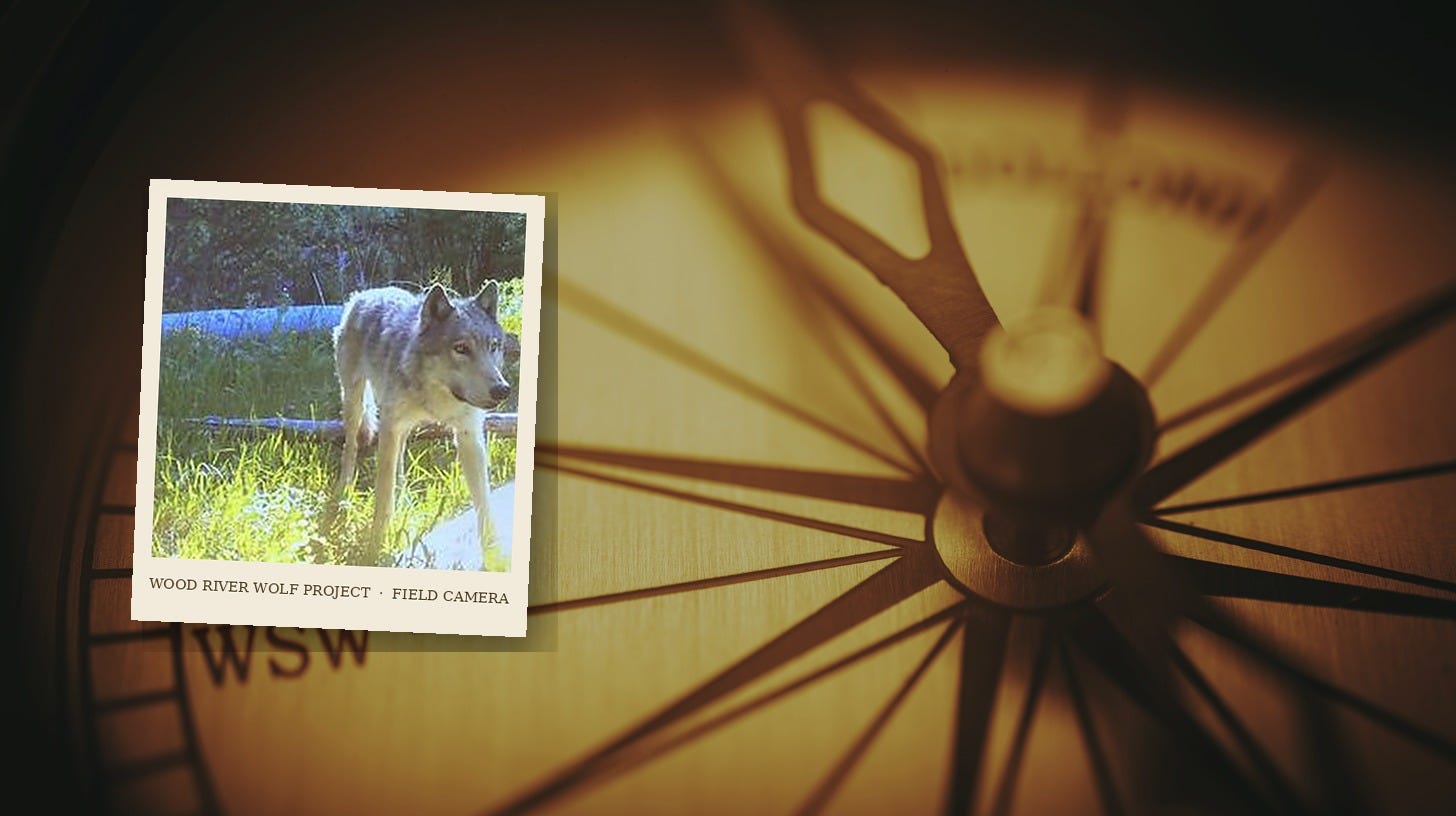
Most people think wolves tell us where the wild still exists.
Their most important lesson for us is harder to see:
Where balance has been lost.
For most of my life, I have studied wolves without scopes or binoculars.
Through field cameras mounted to fenceposts and pine tree trunks. Through tracks pressed into snow and mud — a front paw here, a drag mark there, the story of a hunt written across a hillside. Through their howls answered across a drainage in the dark. Through the kills they leave behind, and the way they move across a landscape they know better than we ever will. Through studying what draws them to the livestock they’ve killed on one ranch but not the next.
Being a wolf is being wild — existing on a level humans cannot easily comprehend. I don’t want to change that, so we avoid disturbing them unless it helps save their lives. The fact that anything truly wild still exists is a kind of miracle. It means the influence of modern humans still has limits. There are still places that are not fully under our control.
Which means that most of what I know about wolves, I have learned from a distance — from the margins, from the clues they leave behind.
What wolves reveal
As apex predators, wolves reveal the architecture of a living system in a way that almost nothing else can.
Where they are absent, imbalance follows.
Ungulates linger too long in the same draws and drainages, cropping willows and aspen to the root. Plant diversity thins. The system loses complexity — quietly, gradually — in ways that are easy to miss until they are very hard to reverse.
Where wolves return, relationships begin to recalibrate.
Elk and deer begin to move again — not fleeing in panic, but shifting to smaller groups, choosing forest over open meadows, using the landscape differently in the presence of a predator. Willows recover along creek banks. Recovering willows feed beaver. Beaver engineer wetlands. Wetlands create habitat for cranes, songbirds, amphibians.
Carrion from wolf kills feeds eagles, ravens, bears — and the smaller scavengers we rarely think about and almost never see.
Yellowstone made this visible to the world. But it is happening, quietly, wherever wolves are allowed to be wolves in habitat that can support them.
In our own study area in Idaho’s Blaine County — twelve hundred square kilometers of working public lands carrying one of the highest densities of sheep anywhere in wolf range in the West — we have watched this unfold firsthand.
Moose, elk, and deer, yes. But also cougar, bear, coyote, pine marten, wolverine, porcupine, sandhill cranes, eagles.
A community of species with no single author, but one that depends — in ways we are still working to understand — on the presence of wolves moving through the land.
This is the tapestry.
Wolves are one of the threads that hold it together.
Pull that thread, and the whole weave begins to unravel.
The mirror they hold up
But the most urgent lesson wolves offer is not about wolves at all.
It is about us.
In twenty years in the field studying wolves and livestock, we have learned that when our use of a shared landscape exceeds what that landscape can carry, conflict is often the first signal that balance has been lost.
Not the only signal — but the one that is hardest to ignore.
A dead sheep. A missing calf. Tracks leading away from a pasture in the early morning.
Wolves become lightning rods for tensions that are older and deeper than those of us alive today — tensions over land, over livelihood, over who belongs and who decides.
The wolf is visible. Present. Easy to blame.
The longer history — how a landscape came to be used the way it is — is harder to see, and harder still to talk about.
Our instinct, when we feel threatened, is to react.
To control. To remove what is making us uncomfortable. To kill.
And in doing so, we forfeit the most valuable thing the wolves were offering us:
A chance to see our own imbalance clearly.
This is what I mean by the wolf as compass.
They do not tell us where to go.
They tell us where we are.
Bluntly, they tell us how far we’ve strayed in relation to our stewardship of nature.
Another path: Wood River
In 2008, our Wood River Wolf Project stakeholders set out to find a different way.
The premise was simple, even if the execution was not: instead of defaulting to lethal control when wolves and livestock came into conflict, we would try to understand what was driving the conflict — and change our practices accordingly.
Herders were paired with multiple livestock guardian dogs. We timed field deployment to the season when wolves and sheep most overlap. We used nonlethal sound and light deterrents that simulate human presence through the night when livestock are most vulnerable.
We built working relationships among ranchers, agency staff, and conservationists — people who do not always agree on much, sitting at the same table anyway, because the problem required it.
Most importantly, we observed.
We let the wolves teach us — about their behavior, their territory, their movement through the seasons. We tracked where they traveled, what they were doing, where the pressure points were.
And we adapted.
Year by year.
The results, sustained now for nearly two decades:
Livestock losses in our project area have remained at the lowest level anywhere in the Western USA where dense livestock operations and resident wolf packs overlap.
Not through any single innovation.
Through attentiveness. Through adaptation. Through the willingness of people who had reason to distrust each other to keep working together.
And in that same landscape, life has flourished.
The diversity of species moving through the area — predators and prey, raptors and scavengers, small mammals and wetland birds — is not incidental.
It is the evidence of what coexistence, practiced seriously, can produce.
What we owe the lesson
The wolves have been teaching for as long as I have been watching.
They are still teaching now.
Kinship is not sentiment. It is recognition — that we belong to the same living system, that our fate is bound to its health, that what we do to the land, we do also to ourselves.
Coexistence is not passive tolerance.
It is not simply choosing not to shoot.
It is active stewardship — the ongoing, effortful work of learning to live in the presence of wildness. Of adapting our practices to what the landscape is telling us. Of choosing, again and again, to pay attention.
The question the wolves keep asking — the one we carry every morning in the field — is whether we are willing to learn.
I have watched people who disagreed about nearly everything find their way to a shared table and stay there. I have watched a landscape nicknamed the Sheep Superhighway — a place that was supposed to be impossible for wolves — become, quietly, a place where wolves and working ranches and a full community of wild species manage to thrive.
It is not simple.
It is not perfect.
But it is real.
That is what the compass is for.
The Wood River Wolf Project has operated in Idaho’s Blaine County since 2008, covering approximately 1,200 square kilometers of working public lands. The project is a collaboration among ranchers, agencies, and conservationists focused on nonlethal coexistence between wolves and livestock. These are species from our field cameras. Diversity is the key to healthy ecosystems. Enjoy and please subscribe! For only $8 a month, you can support this work. Want to learn more? Visit Wood River Wolf Project
Suzanne Asha Stone is an international expert in human–wildlife coexistence and the founder of the International Wildlife Coexistence Network (IWCN). Their work focuses on advancing science-based strategies that enable people and wildlife—especially large carnivores—to coexist sustainably in landscapes.
The IWCN collaborates with practitioners, researchers, and communities worldwide to reduce conflict, improve policies, and build systems that support both biodiversity and human livelihoods.
This essay reflects a central idea in their work:
Coexistence doesn’t begin in remote landscapes.
It begins where we live.
Why Subscribe
If you’ve read this far, you already understand something important:
The future of wildlife isn’t decided only in protected areas.
It’s shaped by everyday decisions—what we plant, what we tolerate, how we share space.
This publication explores those intersections—where ecology, human behavior, and conservation meet.
By subscribing, you’re not just supporting writing.
You’re supporting the broader mission of the International Wildlife Coexistence Network:
Advancing practical, science-based coexistence strategies
Supporting communities living with wildlife
Shifting conservation toward long-term, functional systems
For as little as $8 per month, your support helps turn ideas into action.
Awesomely written narrative concerning wolfs
Spectacular essay in style and substance, indeed I hope you will pull all that you have seen and thought about into a book. And as a snake biologist veered into anthropology and now ranching heritage breed cattle, which is to say someone who's also spent a career trying to uplift unpopular dangerous animals, I agree with every single word you write...but I think there's one more, likely important piece missing--and the answer lies in staring a bit longer at a heard of Bison, including their heads, or watching the famous video, Battle at Kruger...just sayin for now!